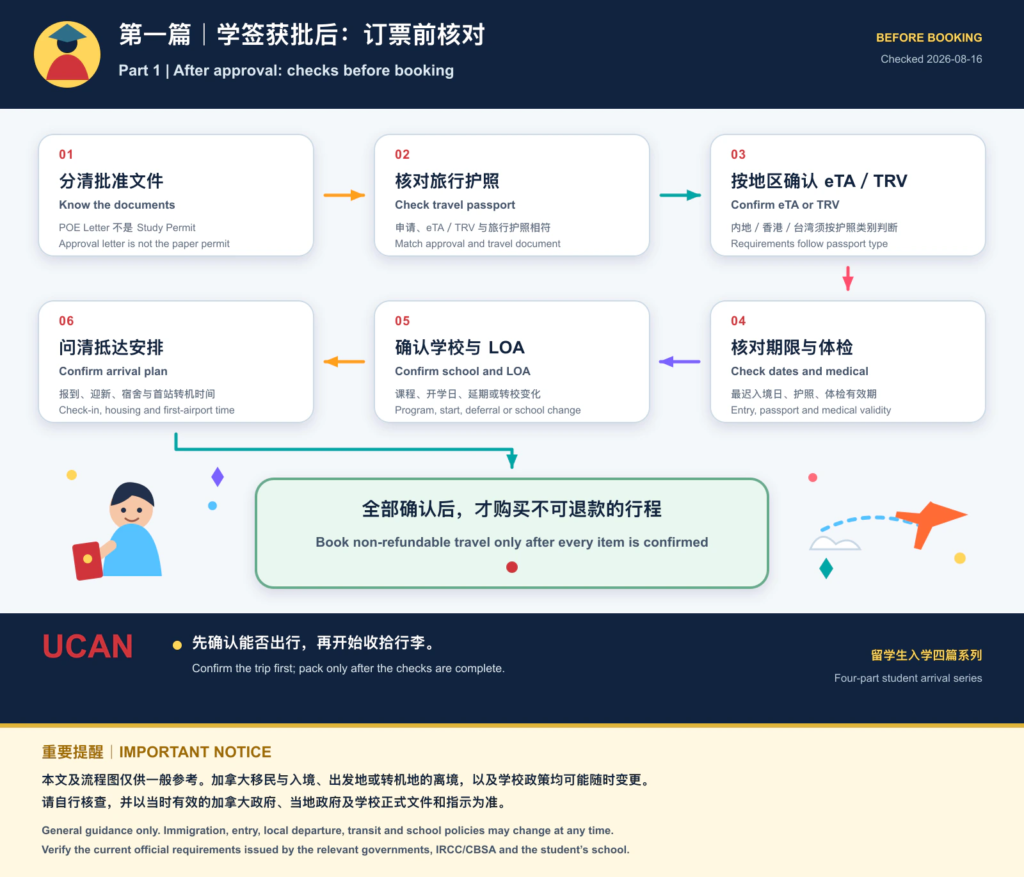
After Approval: Check Your Documents Before Booking a Flight
1. Know what the approval gives you
IRCC normally sends a first-time overseas student a port of entry letter of introduction (POE letter). This is proof that the study-permit application was approved, but it is not the paper Study Permit. A border services officer decides whether to issue the Study Permit when the student first enters Canada. The Study Permit authorizes study but is not a travel document, so the student also needs the correct passport and either a TRV or an eTA.
2. Check the passport, TRV or eTA
Use the same passport connected to the approval. A student travelling on a Mainland Chinese ordinary passport normally needs a valid TRV counterfoil in that passport. A Hong Kong SAR or British National (Overseas) passport holder flying to Canada normally needs an eTA linked to the passport used in the application. A traveller using an ordinary Taiwan passport issued by the Ministry of Foreign Affairs with a personal identification number normally needs an eTA; another type of Taiwan passport may require a visa. The requirement follows the passport used for travel, not simply the student’s place of residence.
For a first approved study-permit application, IRCC normally issues the required TRV or eTA automatically. Nevertheless, check the visa counterfoil or the eTA details before paying for a non-refundable flight. If travelling through another country, use the same passport to check that country’s transit requirements.
3. Check every date and personal detail
Download the POE letter from the IRCC account. Check the name, passport details, permit reference and the date by which the student must enter Canada. Confirm that the passport will remain valid; a Study Permit cannot normally be issued beyond the passport expiry date. If an immigration medical examination was required, make sure the result will still be valid on the entry date. IRCC says the result is normally valid for 12 months from the examination date.
4. Confirm the school has not changed
Open the school portal and check that the Letter of Acceptance (LOA), program and start date remain valid. If the school approved a deferral, obtain the updated LOA and make sure the POE letter is still valid. If a post-secondary student changed to another designated learning institution while still outside Canada after approval, the student normally needs a new study-permit application with the new LOA before travelling.
5. Apply for residence before the school’s deadline
Check residence as soon as the student applies to the college or receives the admission offer; do not simply wait for the Study Permit without asking Housing what can be done first. The academic application, acceptance of admission and residence application are separate processes. Colleges also use different systems. Algonquin College has no fixed residence-application deadline, processes applications first come, first served and generally recommends applying by March or April for the best chance. Fanshawe College normally opens fall residence applications on February 1 and describes June 15 steps for its fall first-year guarantee; however, international students must also follow Fanshawe’s separate form and approved-visa-proof instructions. These are examples from colleges listed by UCAN, not universal deadlines. The student must follow the date, process and time zone published by their own campus and Housing Office.
Open the official housing portal as soon as the student applies to or receives an offer from the school. Check who qualifies for a first-year guarantee, whether a separate application fee or deposit is required, and whether accepting the academic offer is another condition. Submitting an application does not necessarily confirm a room. Monitor both the application email and school email. When a residence offer arrives, accept the contract and pay the required deposit or first instalment before the offer expires. Save the final confirmation showing the residence term, payment status and move-in instructions. If the student is wait-listed or misses the guarantee deadline, immediately ask Housing about the next round and prepare a safe temporary or off-campus alternative.
6. Ask the school before booking
Email International Admissions or the International Student Office with the student number, program and proposed arrival date. Ask for the earliest sensible arrival, latest permitted arrival, international-student check-in, orientation or placement-test dates, residence move-in hours, after-hours key collection and airport transport. IRCC sets no universal number of days for early arrival; the student should allow reasonable time to settle. The student cannot work on or off campus before the study program begins.
Book accommodation from the actual arrival day. Save the full address, postal code, telephone number and after-hours instructions. If the itinerary connects through a Canadian airport before the final city, leave a generous layover: immigration processing and Study Permit issuance happen at that first Canadian port of entry.
7. The ready-to-book test
Do not pay for a non-refundable trip until the passport, TRV or eTA, POE letter, current LOA, medical validity where applicable, school dates, accommodation and first-airport connection time have all been checked. Once every item is confirmed, continue to Part 2 and build the carry-on document folder.
Important notice
This article and its flowchart provide general practical suggestions only. Canadian immigration and entry requirements, departure rules in the student’s place of origin or transit point, and school registration policies may change at any time. Before booking or travelling, readers must independently check and follow the current official documents and instructions issued by IRCC, CBSA, the relevant local authorities, the airline or transit authority where applicable, and the student’s school. If this guide differs from an official requirement, the current official requirement prevails.
Official links to check before acting: IRCC—Prepare for your arrival · IRCC—Entry documents by passport · Algonquin College—Apply to residence · Fanshawe College—Apply to residence · Conestoga College—Residence and payment information