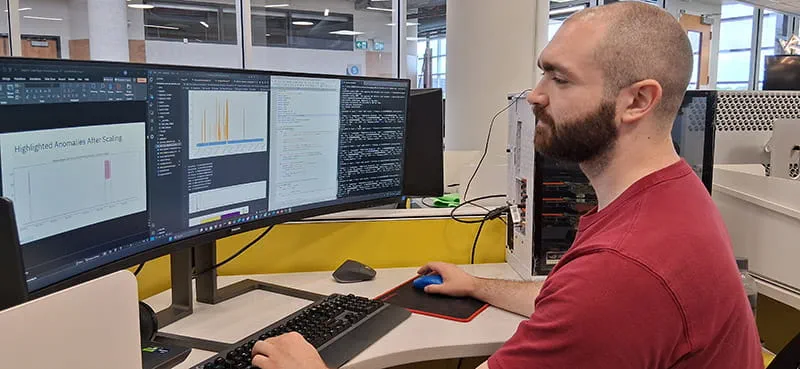
One of the many things Kyle Galway loves about computer science is how algorithms can be used to solve real-world problems.
“It’s fascinating to see how these little structures of logic can be applicable to more things than just computers or data sets,” says the Mississauga, Ont. resident. “For example, the deadlock avoidance algorithms that we use in operating systems (ensuring that processes aren’t waiting on resources that are locked by other processes) are also used by traffic lights.”
Ten years ago, Galway was dealing with a different type of deadlock: a struggle to advance his education. He had enroled in Sheridan’s Computer Programming diploma directly after finishing high school, only to quit the program after one semester and begin working at a local restaurant instead. “I had some personal growth I needed to go through before I was ready to apply myself in an academic environment,” says Galway, who progressed from line cook to lead cook during his six-year tenure with the restaurant. “It gave me time to think and mature.”
Galway would once again depart Computer Programming before completing it — but for a very different reason. He took a pathway into Sheridan’s three-year Computer Systems Technology – Software Development and Network Engineering because the advanced diploma program included a co-op placement, which he spent helping Sheridan’s Centre for Mobile Innovation (now the Centre for Applied AI, or CAAI) collaborate with Rogers on a project that focuses on 5G autonomous vehicle research and development.
The creativity and expertise Galway demonstrated during the co-op led one of his professors to suggest he once again pathway into a different program — this time to Sheridan’s Honours Bachelor of Computer Science degree. Galway is currently in the final year of that program specializing in Data Analytics, plans to complete another co-op term with the CAAI, and intends to write a fourth-year thesis project that can serve as a springboard towards post-graduate studies.
Sheridan offers a robust suite of applied computing programs, ranging in duration from eight-month graduate certificates to four-year degrees — including the first cyber security degree in Canada. Many include pathways that recognize prior learning or enable students to easily transition to another area of computer science, and the Honours Bachelor of Computer Science allows students to change specializations midway through the program by taking just two additional courses. Sheridan also recently introduced two unique programs that address Canada’s urgent shortage of skilled professionals in cyber security and cloud security.