1. What has been confirmed?
On September 18, 2026, the International Language Academy of Canada Inc. (ILAC) filed an assignment in bankruptcy and ceased operations. All classes and programs were cancelled. KPMG Inc. was appointed trustee-in-bankruptcy. The closure affects more than one type of student: in-person and online language students, high-school students and career-college students may be covered by different organizations and procedures. This distinction is essential because one solution does not apply to every ILAC student.
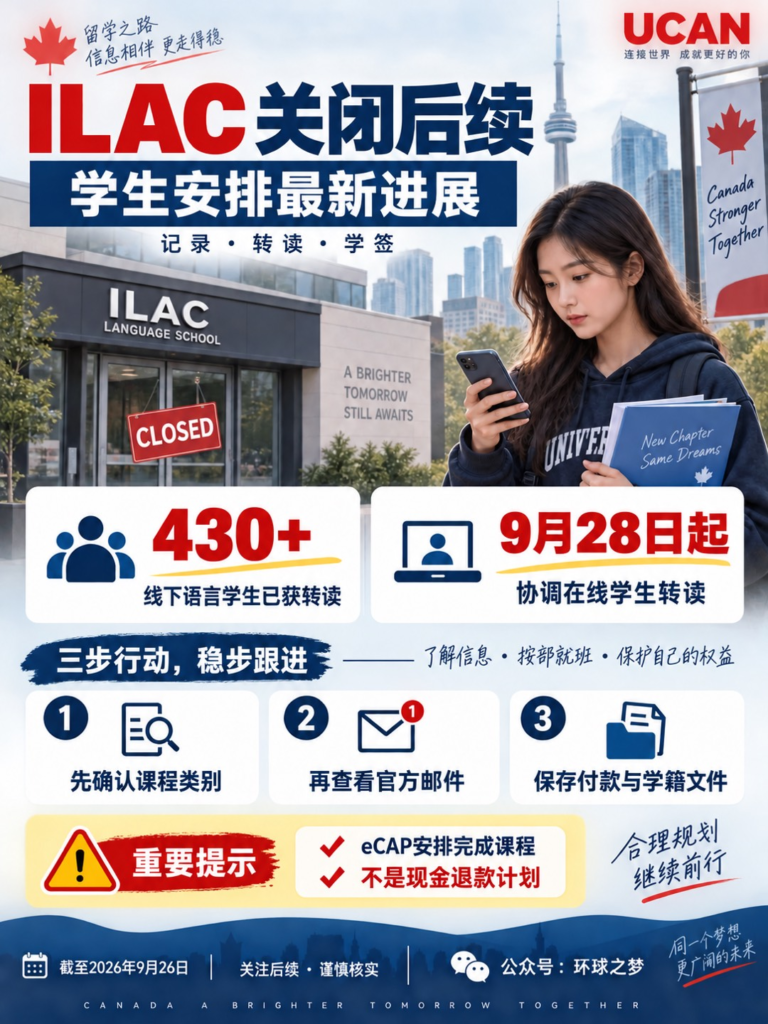
2. More than 430 in-person language students had been placed
Languages Canada reported that ILAC had 1,362 current in-person language students affected by the closure. By its September 22 update, more than 430 had been placed in programs at other Languages Canada member schools. Students whose programs were due to finish soon were given priority. The placement work was still continuing, so “more than 430” was a progress figure, not a final total.
3. What eCAP does—and does not do
The Education Completion Assurance Plan (eCAP) is intended to help eligible language students complete prepaid language education through a comparable replacement program. It is not a cash-refund program or an insurance policy. Languages Canada coordinates placements according to the original program, study mode or location, remaining study length and available capacity. A student cannot require a particular school to accept them. For an equivalent replacement period arranged through eCAP, the objective is no additional tuition; accommodation, transportation, travel, activities, textbooks, materials and other expenses are outside the plan.
4. Online language students have a separate timetable
Languages Canada said it had contacted affected ILAC online language students and planned to begin coordinating placements on Monday, September 28. Students were expected to begin comparable online courses in the following days as individual placements were confirmed, with remaining tuition covered and no additional tuition for the replacement period. Students should rely on the placement email sent directly to them and should not assume that every online learner will start on exactly the same date.
5. High school, career-college and B.C. students need the correct channel
Languages Canada’s placement process described above is for ILAC language programs. It does not automatically cover ILAC high-school or career-college programs. In British Columbia, the Private Training Institutions Regulatory Unit says ILAC Education Group institutions surrendered their designation certificates effective September 18 and may no longer offer career training. PTIRU says it will assist students who were enrolled in approved programs and who may qualify to claim against the Student Tuition Protection Fund. Students in other programs or provinces should not assume that the B.C. process applies to them; they should use the regulator and contact channel for their own program.
6. Refunds, records and immigration status remain separate issues
KPMG lists ilac@kpmg.ca for creditor inquiries, including amounts owing to students, and info@ilac.com for immediate questions about academics, transfers, student records and transcripts. A transfer placement does not by itself settle every refund or creditor claim. Students with a study permit should also check the current IRCC rules before changing schools. Depending on the level of study and individual situation, a new or extended study permit and a new letter of acceptance may be required. Keep copies of the enrolment contract, acceptance letter, payment receipts, timetable, transcript, attendance records, study permit and every email received.
7. A practical checklist for affected students
- Identify your exact program: language, online language, high school or career college.
- Check the email address used in your ILAC registration, including spam and junk folders.
- If Languages Canada has already contacted you, avoid sending repeated messages unless you have important new information.
- Do not pay another school or accept a non-member placement before confirming how it affects eCAP, your academic path and—if applicable—your immigration status.
- Send money-related creditor questions to KPMG and records or academic questions to ILAC’s listed student contact.
- If you hold a study permit, verify the school-change requirements on the IRCC website before starting at a new institution.
Sources
- ILAC official closure notice
- KPMG: International Language Academy of Canada Inc.
- Languages Canada: September 23 clarification and placement updates
- British Columbia PTIRU: ILAC Education Group closure notice
- IRCC: Changing your school or program
- CityNews: Closure leaves students seeking answers, September 24