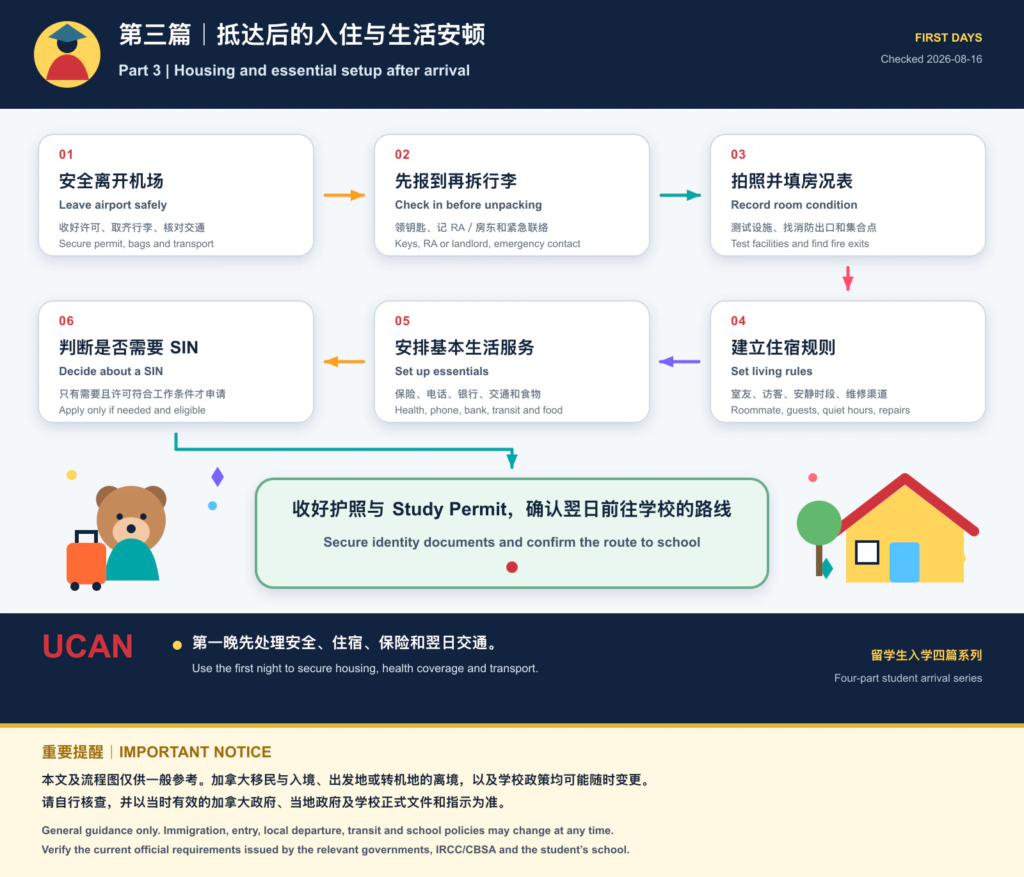
Your First Stop in Canada: Housing and Essential Life Setup
1. Leave the airport safely
Put the new Study Permit inside the document folder and take a private backup photo. Collect every bag, message family and contact the pre-arranged pickup, residence or landlord. Check the driver and destination before entering a vehicle. Keep the passport and Study Permit on the student, not inside luggage in the trunk.
2. Check in before unpacking
Before leaving the airport, open the final residence confirmation—not merely the original application. Confirm the residence name, building, check-in desk, assigned move-in date or appointment and after-hours instructions. If the student has not accepted a contract, completed the required payment or received confirmation of a space, contact Housing and go to the pre-arranged temporary accommodation; do not assume a room will be available on arrival.
For school residence, go to the location named in the move-in email; it may be a central desk rather than the residence building. Show the requested photo ID, sign the check-in record, collect the key or access card and welcome package. Ask for the Residence Advisor’s name and contact, the after-hours desk, lockout procedure and emergency number.
Before unpacking, photograph the room, furniture, stains and damage. Complete the room-condition or inventory form before its deadline. Test the key, lights, heating, taps, toilet, smoke detector and internet. Locate the fire exit and meeting point. Learn how laundry, rubbish, recycling, mail and parcels work, then read the rules on guests, quiet hours, cooking and shared spaces.
3. Start the roommate relationship clearly
Introduce yourself, compare sleep and class schedules, and agree on basic rules for noise, cleaning, food and shared items. Report urgent safety or maintenance problems through the official residence channel instead of attempting a dangerous repair.
4. If the housing is off campus
Meet the landlord or authorized representative, inspect the unit together, record its condition, collect every key and confirm how rent, utilities, internet, repairs and emergencies are handled. Keep the signed lease and payment records. Do not leave the original passport or Study Permit with a landlord; show it for a legitimate identity check and provide only a reasonably required copy.
5. Establish essential services
Confirm health coverage from the actual arrival date. Medical coverage for international students differs by province and school: a student may use a school plan, qualify for provincial coverage or need temporary private insurance. Save the insurance card, policy number, clinic and emergency details offline. Learn that 911 is for police, fire or medical emergencies, and store campus security and residence contacts separately.
Set up reliable Canadian telephone service, a bank account if needed and the local transit card or student pass. Buy basic food and weather-appropriate clothing, learn the route home and avoid carrying every original identity document during ordinary errands.
6. Decide whether a SIN is actually needed
Apply for a Social Insurance Number only if the student needs it and is eligible to work. For a temporary resident, Service Canada requires a Study Permit stating that the student “may work” or “may accept employment,” plus a valid secondary identity document such as a passport. A SIN does not create permission to work, and a student cannot work before the study program begins. Keep the SIN confidential; it is not a general student-identification number.
7. Finish the first-night check
Store the passport and original Study Permit in a secure, dry place. Charge the phone, test the alarm, save the full accommodation address and confirm the route to school. Once housing, health coverage, communication and the next morning’s transport are ready, continue to Part 4.
Important notice
This article and its flowchart provide general practical suggestions only. Canadian immigration requirements, provincial services, local housing rules and school residence policies may change at any time. Readers must independently check and follow the current official documents and instructions issued by the relevant governments, service providers, landlord or residence, and the student’s school. Current official requirements and the signed housing agreement prevail.
Official links to check before acting: IRCC—Health insurance for international students · Service Canada—Documents required for a SIN · Algonquin College Residence—Move-in and late-arrival guidance